Underinsurance Gap — Your modeled loss vs your declared policy limit — where the limit breaks.
You have an exposure number. Does your policy actually cover it?
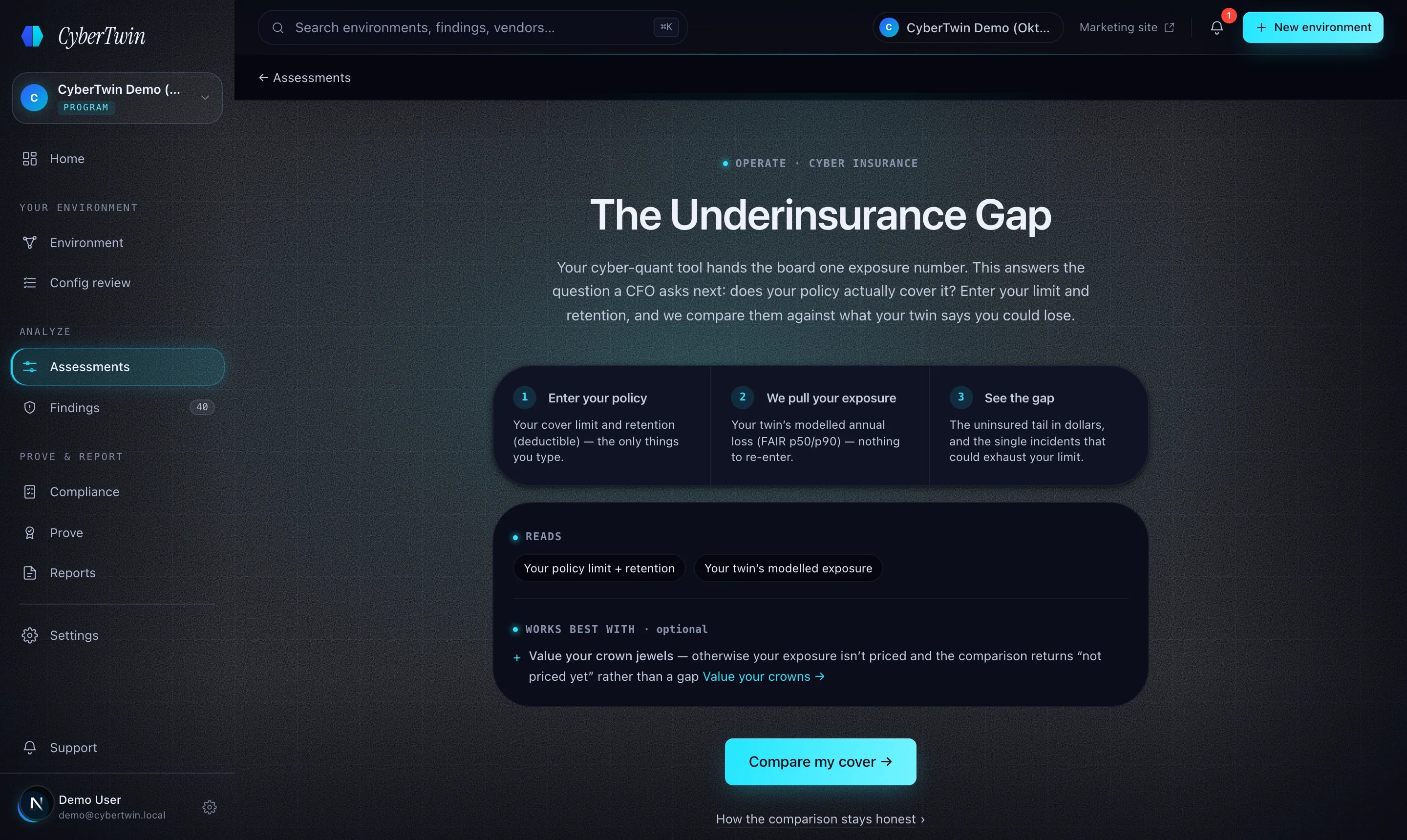
Declare your cyber policy limit and retention. The gap compares them against your twin’s modeled exposure — the uninsured tail in dollars, and the crowns that alone could exhaust your limit.
Exposure is modeled; your policy is what you declare. The gap is modeled exposure above your stated limit — never a claim your coverage is inadequate.
A single number can’t tell you where your limit breaks.
An aggregate exposure figure can’t say which crown’s single loss blows past your cover, by how much, or which route gets there. Your twin’s attack graph can — so the gap is specific.
The twin prices exposure per crown jewel — a FAIR loss distribution for each one, not a single blended portfolio number. Your declared limit and retention overlay that distribution, so the readout names the specific crown whose single loss would break the limit, and by how much.
And because the exposure comes from the same engine that draws your attack paths, the fix rides along: the cut that closes a path also lowers the modeled exposure. An underinsured tail shrinks when you take the one move the twin already recommends.
Enter the policy you hold
Limit, retention, the exclusions that matter — declared by you, from the schedule you already have.
The twin prices your exposure
The same modeled ALE that prices your attack paths — labeled modeled, derived from your uploads.
The gap, stated honestly
Where modeled exposure exceeds the declared limit, the gap is shown with both numbers — never a claim your coverage is inadequate, never insurance advice.
Your modeled exposure, against your cover.
Declare the limit and retention; the twin does the rest. A modeled example from the fictional Acme Capital estate.
Modeled exposure (FAIR) vs a declared limit. The tail is modeled exposure above your stated cover — not a claim your policy is inadequate. At the p90 tail the gap widens to $6.0M.
Modeled, declared, and never overstated.
Insurance is the one place a modeled number must be handled with care. We label what’s modeled and what’s declared, and refuse a coverage verdict we can’t stand behind.
Exposure is modeled; the policy is what you declare.
We take your twin’s FAIR-modeled exposure and the limit + retention you enter. The gap is “modeled exposure above your stated limit” — never a claim that your actual coverage is inadequate.
No policy, no fabricated gap.
Haven’t entered a limit? We don’t invent one or imply you’re exposed. Enter your policy and the comparison appears — not before.
Unpriced means unpriced — never “covered”.
If your crowns aren’t valued yet, we say your exposure isn’t priced and refuse to imply you’re within your limit. We still flag any single crown whose loss alone exceeds the limit.
Decision support, not insurance advice.
Sub-limits, exclusions, and aggregation live in your policy wording, not this model. Every result says confirm with your broker.
The same engine that prices your paths.
Where do the policy terms come from?
Is the gap a claim my coverage is inadequate?
What if my crowns aren’t priced yet?
Exposure is modeled; your policy is what you declare. The gap is modeled exposure above your stated limit — never a claim your coverage is inadequate, and not insurance advice.
Is your limit enough for what your twin says you could lose?
Included in the Operate tier — no add-on, no separate SKU.
Priced by the same FAIR engine, over an attack graph cross-stitched from the 15 security tools we support · 26 MITRE ATT&CK techniques · 9,000 automated tests
Full coverage & honesty detail → /features#coverage
The recurring assessment work, done for you — refreshed on demand as your environment changes.
The dollar estimate, the 4-day 8-K clock, and the draft — for your disclosure committee.
Deep dive →A signed, dated proof a crown jewel is NOT reachable — re-checkable without trusting us.
Deep dive →If this vendor is breached, what do they reach inside you?
Deep dive →